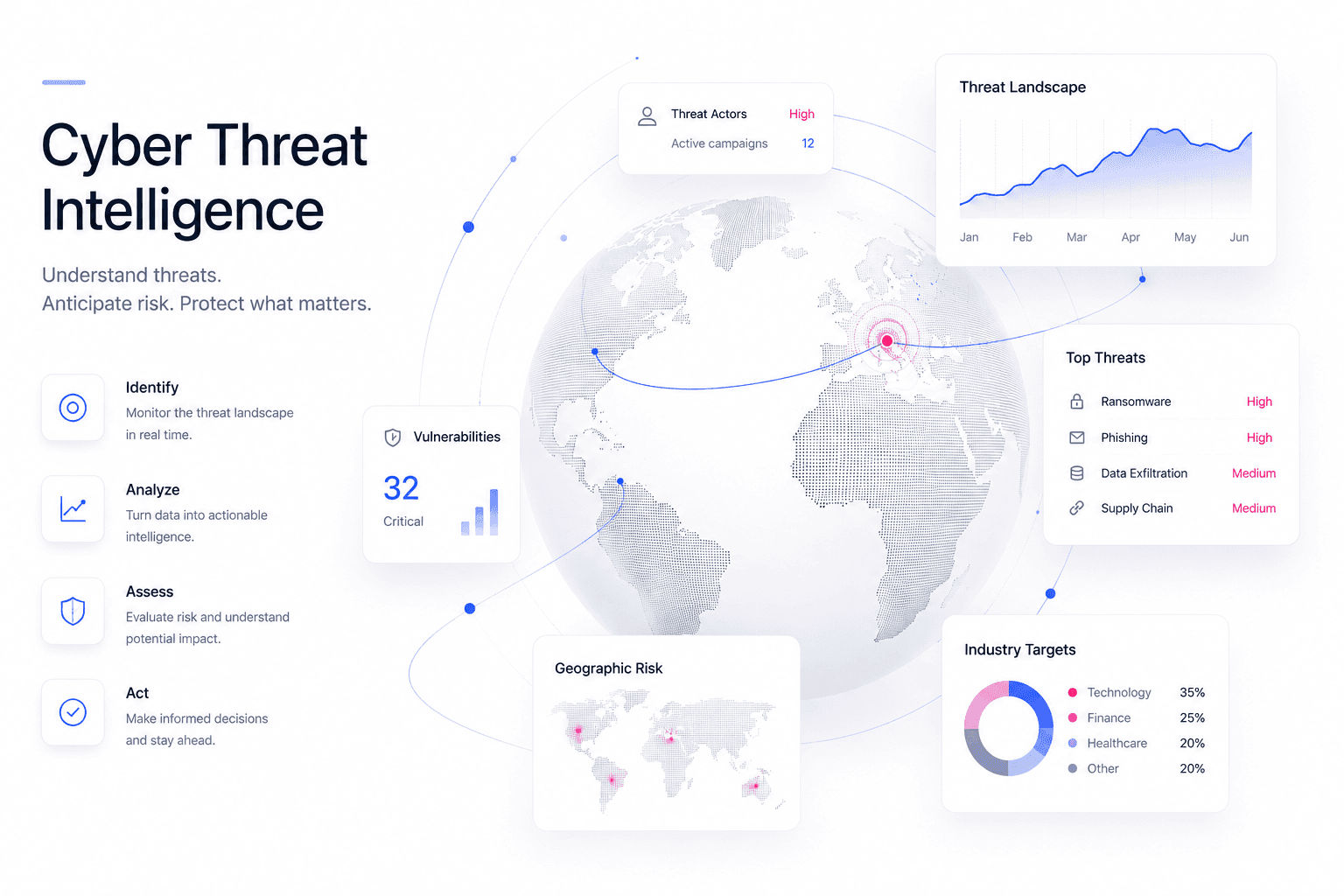

Cybersecurity is undergoing a fundamental shift. As artificial intelligence accelerates both attack and defense capabilities, traditional, static risk assessment models are no longer sufficient. Organizations can no longer rely solely on past incidents to prepare for future threats. Instead, they must anticipate them. AI-powered cyber risk simulation introduces a new paradigm, one where security is not just analyzed, but actively modeled, tested, and predicted before real-world attacks occur.
AI-Powered Cyber Risk Simulation: Rethinking How We Model Security Threats
As artificial intelligence reshapes the cybersecurity landscape, traditional risk assessment methods are quickly becoming outdated. Static audits, compliance checklists, and historical incident analysis are no longer enough in a world where threats evolve dynamically often driven by AI itself.
This is where projects like ai-cyber-risk-simulation come in, introducing educational approach: simulating cyber risk using AI-driven models.
Demo version of the model: https://github.com/main5equence/ai-cyber-risk-simulation
Why Cyber Risk Simulation Matters Today
Most organizations still rely on reactive security strategies:
Reviewing past incidents
Running periodic audits
Applying known fixes to known problems
But modern threats don’t play by those rules.
AI enables attackers to:
Generate sophisticated phishing campaigns at scale
Discover vulnerabilities faster
Adapt attacks in real time
This creates a gap: defenders rely on static analysis, while attackers operate dynamically. Simulations bridges that gap.
What Is AI Cyber Risk Simulation?
The ai-cyber-risk-simulation project represents a shift toward predictive and probabilistic security modeling.
Instead of asking:
“What went wrong in the past?”
It asks:
“What could go wrong and how likely is it?”
At its core, the project focuses on: modeling cyber attack scenarios, simulating attacker behavior, quantifying risk using probabilistic methods. This transforms cybersecurity from a reactive discipline into a decision-support system.
How It Works
1. Scenario Definition
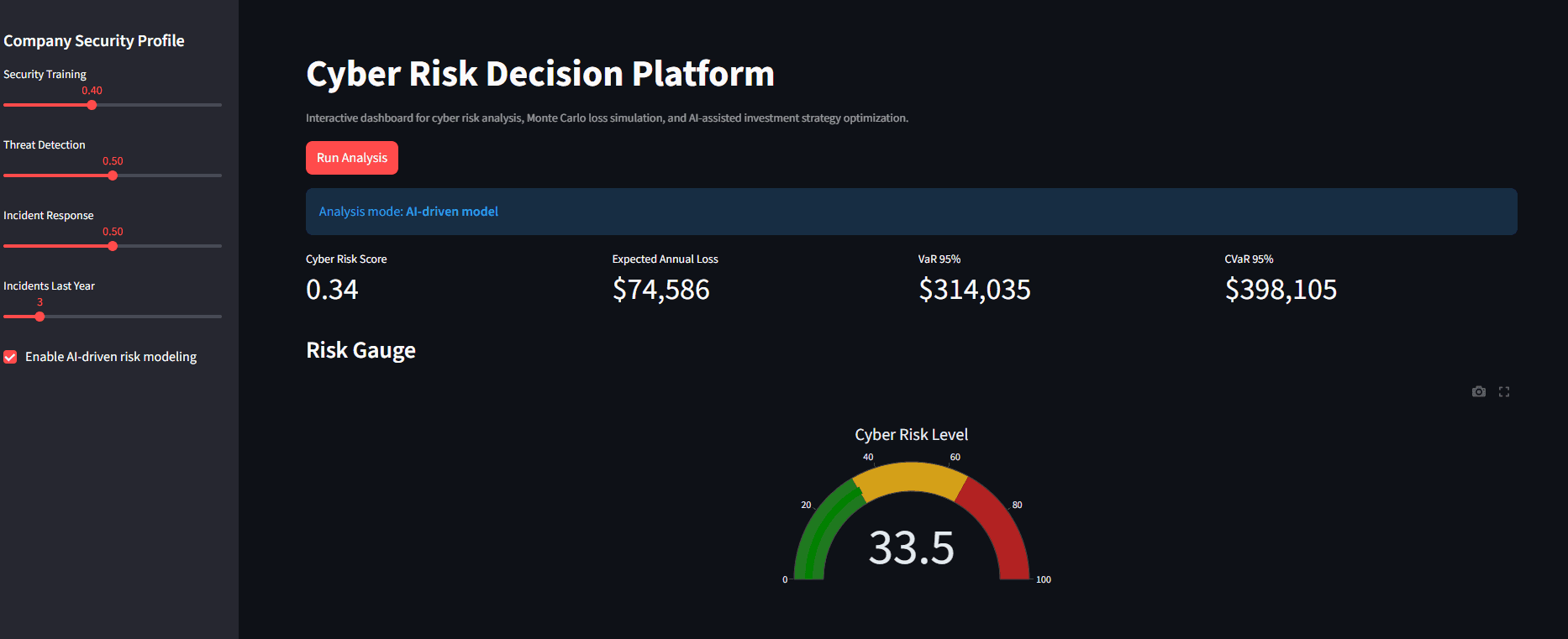
Define company security profile:
Security Training
Threat Detection
Incident Response
Incidents Last Year
Each simulation generates a potential financial loss, which is then used to estimate:
Expected Annual Loss (EAL)
Value at Risk (VaR)
Conditional Value at Risk (CVaR)
2. Attack Exposure by Scenario
Phishing
Ransomware
Data Breach
Insider Threat
3. Investment Strategy Optimizer
Detection Focus
Balanced
Resilience Focus
Zero Trust Plus
Cost Efficient
Cyber Risk Modeling
The system computes a cyber risk score between 0 and 1.
Risk score interpretation:
0.00 – 0.33 → Low cyber risk
0.33 – 0.66 → Medium cyber risk
0.66 – 1.00 → High cyber risk
Monte Carlo Simulation
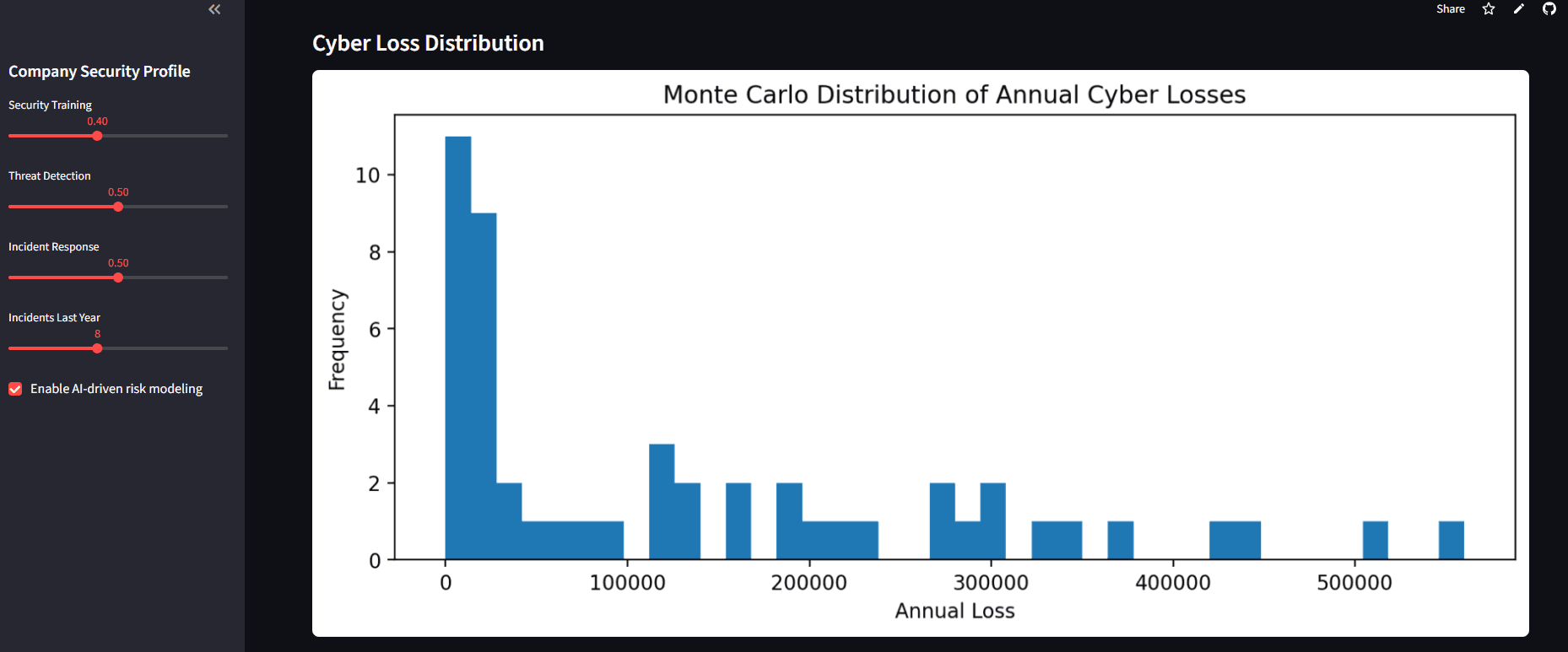
The platform runs thousands of simulated cyber attack scenarios to model uncertainty and potential outcomes.
Key Insights from the Distribution
The distribution reveals several important characteristics:
Most outcomes are clustered at lower loss levels, indicating that in the majority of cases, the organization experiences relatively minor incidents or no significant breaches.
However, the distribution also exhibits a long right tail, representing rare but high-impact events such as ransomware attacks or major data breaches.
These extreme scenarios, although infrequent, contribute disproportionately to overall risk.
Limitations to Keep in Mind
No model is perfect.
Simulations depend on assumptions
Results are only as good as the input data
Rare, unexpected events (“black swans”) remain difficult to predict
That’s why simulation should complement, not replace:
Expert judgment
Real-world testing
Continuous monitoring
Final Thoughts
The ai-cyber-risk-simulation project highlights a major shift in cybersecurity:
From static assessments → dynamic simulations
From reactive defense → predictive modeling
From intuition → data-driven decisions
In an AI-driven world, it’s no longer enough to understand threats after they happen. We need to simulate them before they do.
Continue Reading