
Cyber threats are evolving faster than ever, making cybersecurity increasingly dependent not only on protection, but also on understanding attacker behavior, emerging risks, and the broader threat landscape. This article explores what CTI actually is, how it works, and why it is becoming increasingly important from both a cybersecurity and business perspective.
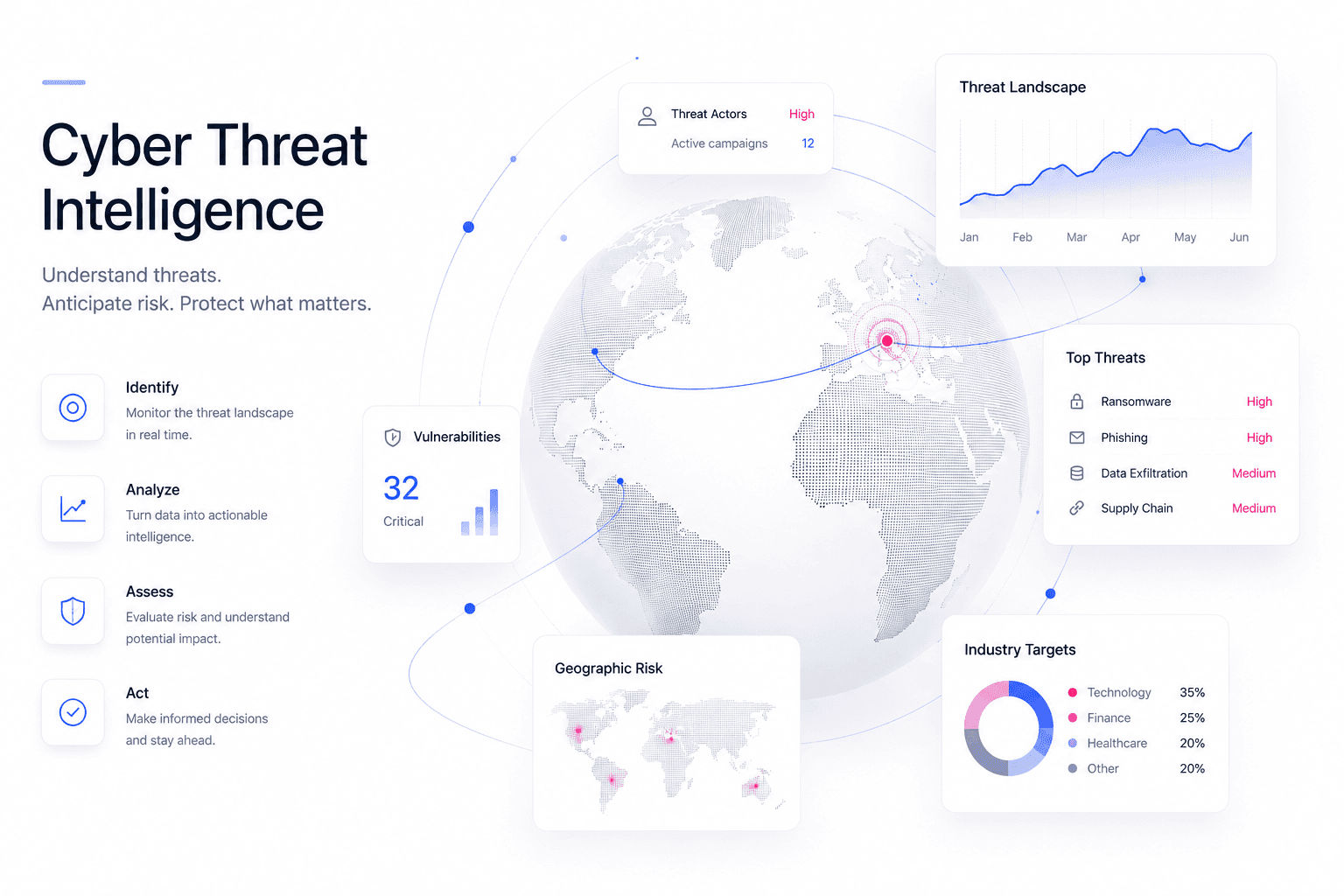
When people hear the term Cyber Threat Intelligence (CTI), they often associate it only with technical cybersecurity operations, malware analysis, or threat feeds. But CTI is much broader than simply collecting information about cyberattacks. At its core, Cyber Threat Intelligence focuses on understanding threat actors, attacker behavior, cybercriminal organizations, attack patterns, and the overall threat landscape in order to better anticipate and understand potential risks before incidents occur. CTI is not only about analyzing malware or vulnerabilities.
It is also about understanding:
who the attackers are
how they operate
what motivates them
which industries they target
which techniques they commonly use
and how their strategies evolve over time
Many threat actors and cybercriminal groups follow recognizable patterns. Some groups focus primarily on ransomware attacks, others specialize in financial fraud, data theft, espionage, or supply chain compromises. Certain organizations target healthcare, others financial institutions, governments, or large enterprises. By studying these groups, their infrastructure, tools, behaviors, and tactics, CTI helps organizations better understand which threats are most relevant to them. This is what makes CTI especially valuable from both a cybersecurity and business perspective. Modern cyberattacks are rarely random.
Attackers often exploit:
known vulnerabilities
human behavior
weak authentication
social engineering
or geopolitical situations
Threat Intelligence helps identify these trends early and provides context that allows organizations to better assess risk. In many ways, CTI transforms cybersecurity from a reactive discipline into a proactive one. Instead of only responding after an attack happens, organizations can focus on understanding indicators, patterns, and signals that may suggest emerging threats before disruption occurs. This becomes increasingly important in an environment shaped by AI, automation, and rapidly evolving attack techniques. Today, cyberattacks can impact far more than technical systems alone.
They can affect:
operational continuity
reputation
customer trust
financial performance
regulatory compliance
and long-term business resilience
Because of this, CTI is becoming increasingly connected to risk analysis and strategic decision-making.
Threat Intelligence supports organizations in:
identifying high-risk areas
understanding potential attack vectors
prioritizing security efforts
improving preparedness
and reducing uncertainty in an increasingly complex digital landscape
While CTI cannot predict cyberattacks with complete certainty, it significantly improves situational awareness and helps organizations better understand how the threat landscape evolves. And in cybersecurity, understanding attacker behavior early often means being better prepared before threats escalate into larger incidents. As cyber threats continue to evolve, CTI is becoming far more than a technical capability. It is increasingly a strategic function that combines cybersecurity, intelligence analysis, risk management, and business resilience.
References
MITRE - MITRE ATT&CK Framework
ENISA - Threat Landscape Reports
National Institute of Standards and Technology - Cybersecurity Framework (NIST CSF)
IBM - X-Force Threat Intelligence Reports
Verizon - Data Breach Investigations Report (DBIR)
OWASP Foundation - Application Security & Threat Modeling Resources
The SANS Institute - Cyber Threat Intelligence Research
Mandiant - M-Trends Threat Reports
CrowdStrike - Global Threat Reports
Cyber Threat Intelligence methodologies and open-source intelligence (OSINT) research.
Continue Reading