
Cybersecurity is often framed as a battle between attackers and defenders. New threats emerge, new technologies appear, and organizations respond with new controls, tools, and processes. But beneath this constant cycle lies a more fundamental challenge: change. Technology evolves. Risks evolve. The digital environment evolves. The question is not whether change will occur, but whether we can adapt to it. This idea forms the foundation of the OrchiCyb philosophy.
When people think about cybersecurity, they often think about protection. Firewalls. Threat detection. Security controls. Compliance frameworks. Incident response. These are essential components of modern security programs, and they will remain important for years to come. Yet there is a question that often receives less attention:
What makes security effective over time? The answer is not a specific technology, framework, or product.
It is the ability to adapt.
A World Defined by Change
Every generation of cybersecurity professionals faces the same challenge. The environment changes. New technologies emerge. Business models evolve. Attackers discover new techniques. Organizations become more connected, more distributed, and more dependent on digital systems.
Today, this process is accelerating.
Artificial intelligence is transforming how organizations operate. Cloud infrastructure continues to expand. Supply chains are becoming increasingly interconnected. Autonomous systems are beginning to make decisions once reserved for humans. The digital landscape is not standing still. Neither are the risks that exist within it. This reality creates a fundamental challenge for cybersecurity.
Security programs are often designed around known threats, known technologies, and known assumptions. But the future is defined by what we do not yet know. The organizations that succeed will not necessarily be those with the largest security budgets or the most sophisticated tools. They will be the organizations capable of learning, adapting, and responding to change.
Why Orchids?
The name Orchicyb is inspired by orchids. At first glance, orchids may seem to be not connected with cybersecurity. Yet they represent one of nature's most remarkable examples of adaptation. With more than twenty-five thousand species distributed across diverse environments, orchids have evolved to thrive under vastly different conditions. They grow in tropical forests, mountainous regions, and even harsh environments where many other plants struggle to survive. Their success is not based on strength alone. It is based on adaptability.
Orchids continuously evolve alongside their environment. They form specialized relationships, occupy unique ecological niches, and develop strategies that allow them to respond to changing conditions. Their story is not simply a story of survival. It is a story of resilience through adaptation. I believe cybersecurity follows a similar principle.
Security Is Not Static
There is a common misconception that security can be achieved once and maintained indefinitely. Organizations often search for permanent solutions.
A tool that solves the problem.
A framework that guarantees protection.
A process that eliminates uncertainty.
Reality is more complicated. Security is not a fixed destination. It is an ongoing process. Every new technology introduces new opportunities and new risks. Every business decision changes the organization's exposure. Every innovation reshapes the threat landscape. This does not mean security is impossible. It means security must evolve alongside the environment it seeks to protect.
Security without adaptation eventually becomes outdated.
Policies become irrelevant.
Controls become ineffective.
Assumptions become dangerous.
The challenge is not simply building defenses. The challenge is ensuring those defenses continue to remain relevant as the world changes.
The Role of Digital Risk
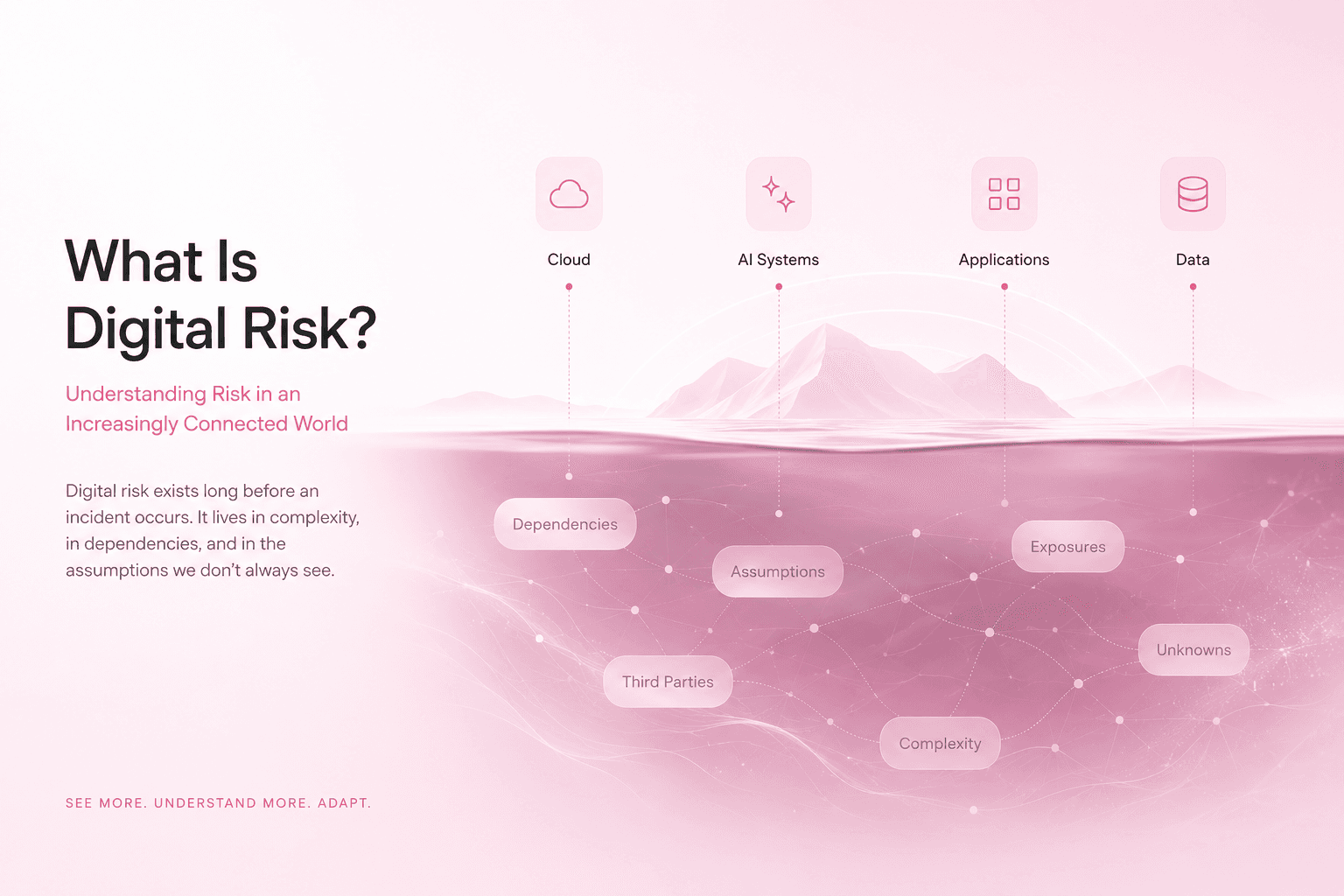
At OrchiCyb, I focus on digital risk because risk often appears before incidents do. An attack is usually the visible outcome of underlying conditions that existed long before the compromise occurred.
Misconfigurations.
Unknown dependencies.
Exposed assets.
Unexamined assumptions.
Rapid technological change.
Understanding these conditions requires more than reactive security. It requires visibility. It requires awareness. And above all, it requires adaptability. Organizations that understand how their risk landscape evolves are better positioned to make informed decisions before problems become crises. This is where digital risk becomes more than a security concern. It becomes a strategic capability.
Building Security for an Evolving World
The future of cybersecurity will not be defined by a single technology. It will not be defined by artificial intelligence alone, nor by automation, compliance, or threat intelligence.
Instead, the future belongs to organizations that can continuously adapt their understanding of risk.
Organizations that challenge assumptions. Organizations that remain curious. Organizations that recognize that uncertainty is not an exception - it is the environment itself.
Looking Forward
Technology will continue to evolve. So will threats. So will organizations. The question is not whether change will occur. The question is how we respond to it.
Inspired by one of nature's most adaptive families, OrchiCyb embraces a simple idea:
Lasting security is built through continuous adaptation.
Because in a changing world, resilience belongs to those who evolve with it.
Continue Reading