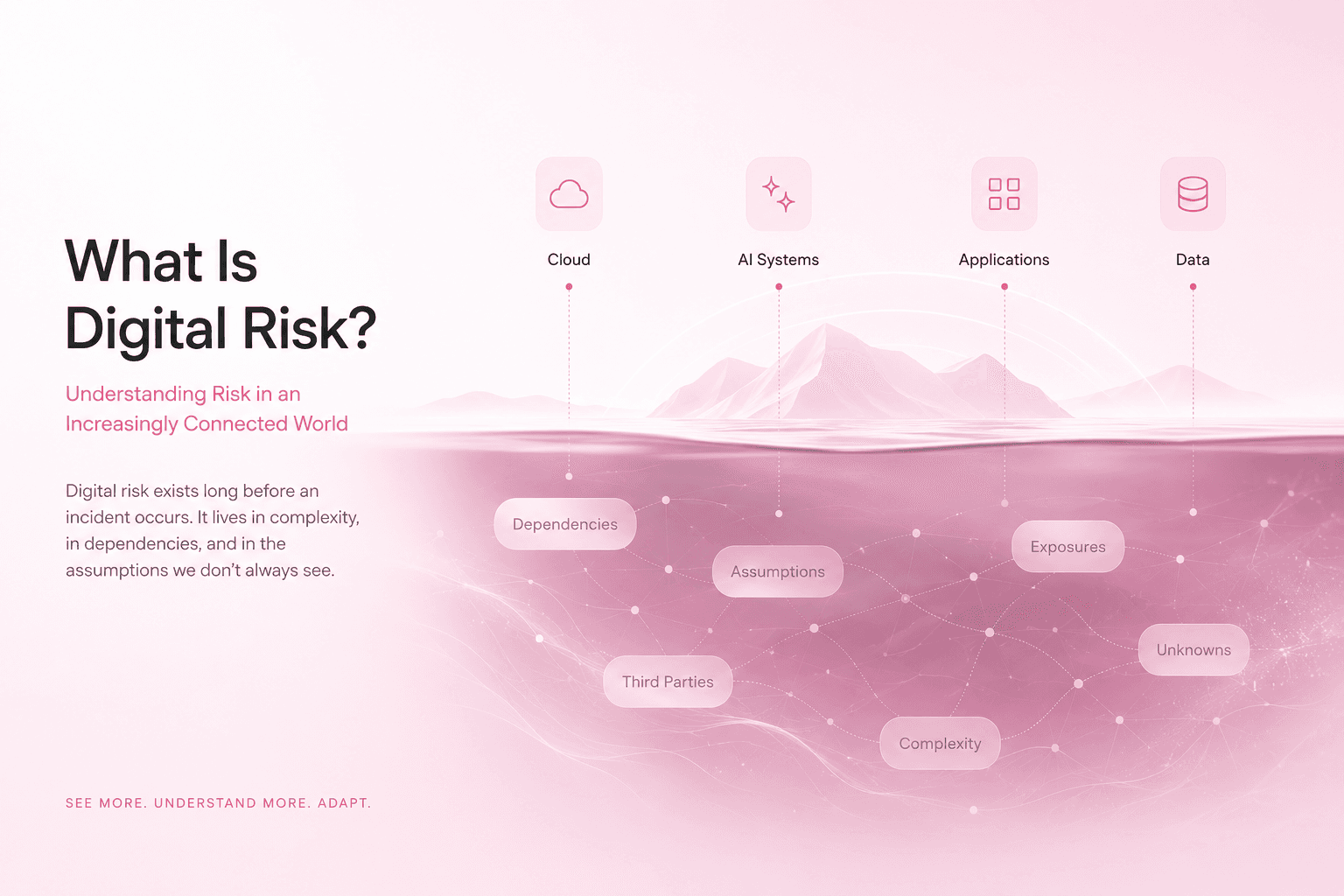

Digital risk is often discussed in the context of cybersecurity, yet the term remains surprisingly misunderstood. Many organizations focus on threats, vulnerabilities, and incidents, while overlooking the broader conditions that create risk in the first place.
Beyond Cybersecurity
When most people hear the word "risk," they immediately think about something bad happening.
A data breach.
A ransomware attack.
A compromised account.
A system outage.
While these events are certainly examples of risk becoming reality, they are not risk itself.
Risk exists before an incident occurs.
It exists in uncertainty. It exists in exposure. It exists in the possibility that something could happen and impact an organization's objectives, operations, reputation, or assets.
Digital risk refers to these uncertainties within digital environments. It encompasses the potential consequences of technology-related decisions, dependencies, vulnerabilities, and emerging threats. Cybersecurity is an important component of digital risk. But digital risk is broader. Much broader.
The Expanding Digital Landscape
Organizations today operate within highly interconnected ecosystems. Cloud providers host critical infrastructure. Third-party vendors process sensitive data. Artificial intelligence assists decision-making. Employees access systems from anywhere in the world. Applications communicate with dozens of external services. Every connection creates value. Every connection also creates exposure. As organizations become increasingly digital, understanding these exposures becomes more difficult.
Many risks no longer originate from a single vulnerability or malicious actor. Instead, they emerge from complexity itself.
A forgotten cloud asset.
An overlooked dependency.
An AI system producing unintended outcomes.
A supplier experiencing a security incident.
A misconfiguration that remains unnoticed for months.
Digital risk often exists long before it becomes visible.
Why Traditional Security Thinking Isn't Enough
Historically, security has often focused on protection. Build stronger defenses. Deploy more controls. Detect threats faster. These activities remain essential.
However, modern environments are too dynamic to rely solely on defensive thinking.
Organizations can no longer assume they fully understand their attack surface. They can no longer assume every dependency is visible. They can no longer assume risks remain static. Technology evolves continuously. The risk landscape evolves alongside it. Managing digital risk therefore requires more than protection. It requires visibility. Awareness. Context. And perhaps most importantly, adaptability.
The Four Dimensions of Digital Risk
While digital risk can take many forms, it often emerges across four interconnected dimensions.
Technology Risk
Risks associated with systems, infrastructure, software, and technical configurations.
Examples include:
Vulnerabilities
Misconfigurations
Legacy systems
Cloud security issues
Operational Risk
Risks arising from business processes and organizational practices.
Examples include:
Human error
Insider threats
Inefficient procedures
Lack of governance
Third-Party Risk
Risks introduced by suppliers, vendors, partners, and external services.
Examples include:
Supply chain attacks
Vendor compromises
External service outages
Emerging Technology Risk
Risks associated with rapidly evolving technologies.
Examples include:
Artificial intelligence
Autonomous systems
Quantum computing
New digital platforms
These categories frequently overlap.
Understanding their relationships is often more important than examining them individually.
Digital Risk Is About Decisions
One of the most important aspects of digital risk is that it is rarely a purely technical problem. Every organization makes decisions. Which technologies to adopt. Which vendors to trust. Which data to collect. Which processes to automate. Every decision carries uncertainty. Digital risk emerges where uncertainty and technology intersect.
This is why managing digital risk is not only the responsibility of security teams.
It requires collaboration across leadership, technology, operations, compliance, and business functions. The goal is not to eliminate risk. The goal is to understand it well enough to make informed decisions.
The Role of Adaptation
I believe digital risk cannot be separated from change. Technology changes. Business environments change. Threat actors change. Assumptions change. Organizations that treat risk as a static problem eventually fall behind. Organizations that continuously adapt are better positioned to remain resilient.
This principle can be observed throughout nature. The species that survive are not always the strongest. Often, they are the ones most capable of adapting to changing conditions.
The digital world follows a similar pattern. Security remains essential. But effective security depends on understanding how risk evolves over time.
Looking Ahead
Digital risk is no longer a niche concern reserved for security professionals. It has become a strategic challenge affecting every organization that depends on technology - which today means nearly every organization.
Understanding digital risk is not about predicting the future with certainty. It is about developing the awareness, visibility, and adaptability needed to navigate uncertainty.
As technology continues to evolve, organizations will face new opportunities and new forms of risk. Those that thrive will not be those that eliminate uncertainty. They will be those that learn how to understand and adapt to it. Because risk is inevitable. How we respond to it is not.
Continue Reading